Secrets of Surah al-Fatihah: How Divine Language Provides a Moral Compass
Authored by Dr. Nazir Khan
Published: April 18, 2025 •Shawwal 20, 1446
Updated: July 10, 2025 •Muharram 15, 1447
Read time: 12 min
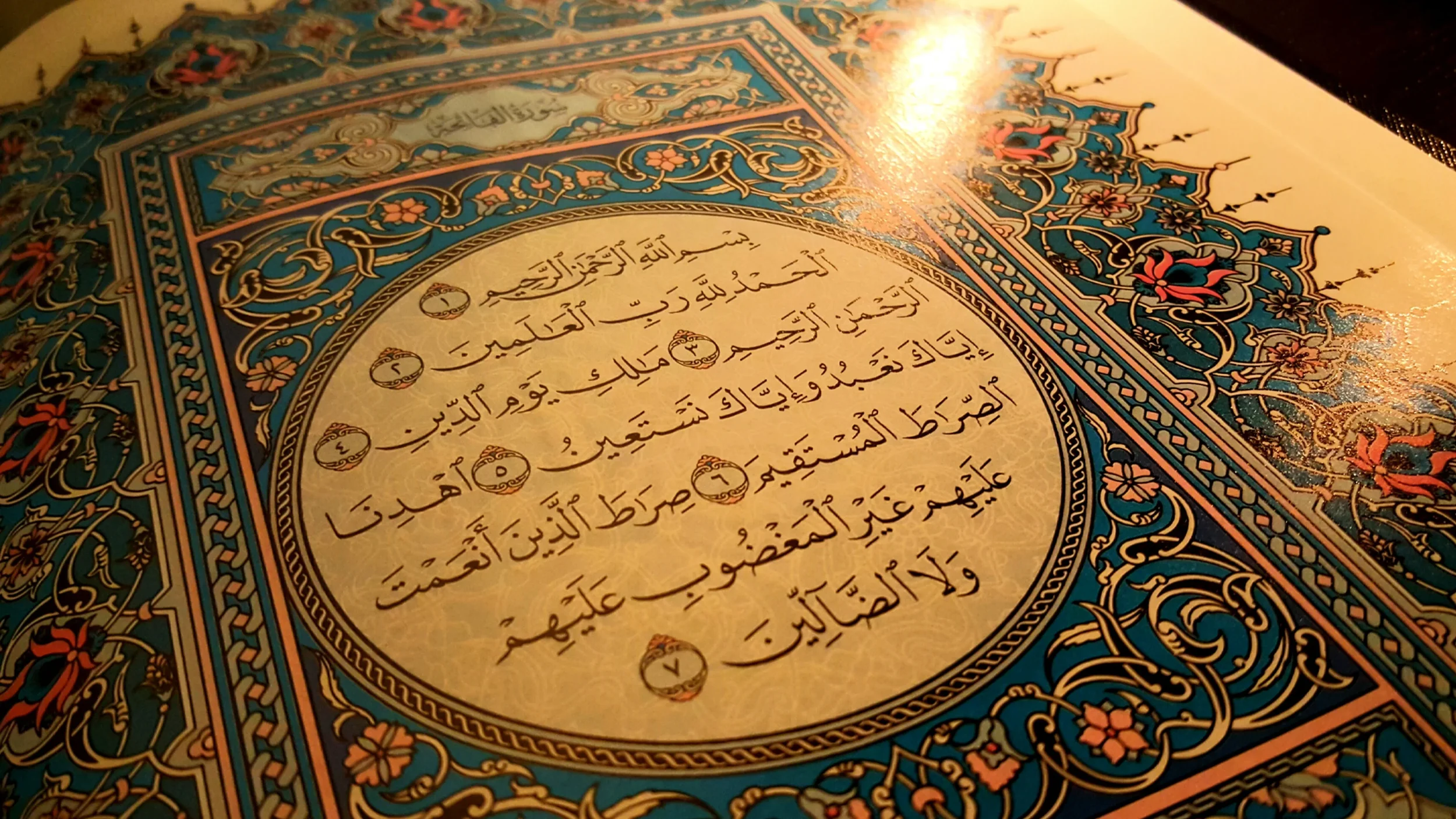
In order to reconnect our hearts with the Qur’an and improve our concentration in ṣalāh, one of the most valuable activities is to reflect deeply on the meanings of Sūrah al-Fātiḥah, the greatest chapter in the Qur’an. It is the opening to the Qur’an for a reason; it contains the keys to receiving the guidance and message of the Qur’an. Despite the fact that this sūrah is so frequently recited, there are countless profound gems that are contained within its verses. Ibn Taymiyya says, “A person may recite a sūrah multiple times—even Sūrah al-Fātiḥah—and yet, in the midst of his recitation, more of its meanings may become apparent to him that never occurred to him before, as if it had just been revealed at that very moment. He thus believes in these meanings, and his knowledge and actions increase. This is something experienced by everyone who recites the Qur’an with contemplation (tadabbur), unlike the one who recites it heedlessly.” 1
This brief blog will review a few of the profound gems related to this sūrah extracted from the works of tafsīr. In seven short verses, we will see how every single word has been perfectly selected to convey the greatest moral lessons. This material is summarized and simplified from the author’s The Straight Path: How Sūrah al-Fātiḥah addresses modern ideologies, which the reader can refer to for further details.
Secret 1: Praise entails ultimate love.
Alḥamdulillah (All praise belongs to Allah) means affirming that all goodness comes from Allah and that He is perfect in every way. With this statement, we are expressing our ultimate love and gratitude to Allah. While the word ḥamd (praise) encompasses shukr (thankfulness), it also goes beyond it, as one praises Allah not only for His blessings but also because of His beautiful names and attributes. It encompasses thanāʾ (another word for praise) but also further emphasizes actions of the heart: making sure that Allah is more dear and beloved to us than anything else. So it functions like a diagnostic scan of our soul by inviting us to examine whether we fulfill its meaning.
Secret 2: Praise of Allah does not depend on us.
The phrase alḥamdulillāh is expressed as a statement of fact but it also serves as an instruction. It is significant to note that the chapter does not express this in the imperative form, either ‘praise God’ (iḥmadū Allah) or ‘Say: praise belongs to God’ (qul alḥamdulillah), but simply makes the declaration directly. It shows us that praising the Creator is the most natural human impulse. It also makes the verse not dependent on human action in order to be fulfilled. It is always true; praise belongs to our Creator whether we choose to recognize it or not. Moreover, by expressing the sentence with a noun rather than a verb (e.g., “We praise Allah”), it is not trapped within a time period.
Secret 3: Know your Rabb, know your purpose.
When we declare that Allah is our Rabb (Lord), what does that entail? As Imam Ibn Jarīr al-Ṭabarī explains, linguistically, the word entails the Master to be obeyed (al-Sayyid al-muṭāʿ), the Owner (al-Mālik), and the One who sets a matter right (al-Muṣliḥ lil-shayʾ) 2
The first meaning entails that we earnestly strive to obey His guidance, the second reminds us that everything we possess is really entrusted to us by Him, and the third reminds us that He created us to fulfill a purpose and gives us the guidance to achieve true virtue. Our Rabb provides us with the best guidance to nurture our souls just as He takes care of everything in the universe. If we truly internalize this meaning, we will see how Islam offers a complete worldview and the path to lead the most ethical and virtuous life.
Secret 4: Everything is a sign of Allah and whoever has Allah has everything.
In the phrase “Rabb al-ʿālamīn” (Lord of the Worlds) we have the Arabic word ʿālamīn. It encompasses everything in existence besides Allah, including all the species of creation existing in every time period, encompassing both the seen and unseen realms. It is linguistically derived from ʿalāmah (sign) because everything in creation serves as a sign of God. Imam Abū Ḥafṣ al-Nasafī explains that grammatically the word Rabb has been connected via the genitive construct (iḍāfah) to “al-ʿālamīn” as if to say, “How magnificent am I that all creation belongs to Me, and how magnificent are My beloved servants that I am theirs!” 3
Secret 5: Allah’s love is even greater than a mother’s love for her child.
The chapter emphasizes Allah’s attribute of raḥmah (mercy), meaning that He is compassionate, benevolent, caring, loving, merciful, and kind. The word is linguistically linked to the word raḥim (womb), which emphasizes the profound nature of the compassion of Allah towards His creation, greater than a mother’s love and care for her child. 4
Secret 6: Allah’s justice is perfect.
The verse “Master of the Day of Judgment” reminds us of the day on which God’s perfect justice will be fully manifest. On that Day, God will say:
I am the true King (al-Malik), I am the true Judge (al-Dayyān); it is not fitting for anyone from the people of Paradise to enter Paradise, nor for anyone from the people of Hell to enter Hell, until I judge any grievance of his, even if it be as little as a slap. 5
This is the perfect justice and absolute accountability that Islam teaches, such that in the court of Divine Justice there will be retribution for even the slightest infraction against the rights of another.
Secret 7: The grammatical shift and the psychological shift.
From the Islamic perspective, acquiring sound knowledge of God and His divine attributes is the basis for knowing how to live in this world and pursue ethical conduct. We see this mirrored in al-Fātiḥah. There is a grammatical shift from speaking about Allah to speaking directly to Allah: “Praise be to Allah” to “You alone do we worship” (iyyāka naʿbudu). This shows that one is prepared to converse with God directly after acquiring a sound understanding of His attributes of perfection.
Secret 8: All the categories of tawḥīd are in Sūrah al-Fātiḥah.
In addition to teaching the etiquettes of worship and supplication, the categories of tawḥīd (monotheism) are also found in the opening verses of al-Fātiḥah. One finds tawḥīd al-rubūbiyyah (oneness of Allah’s Lordship) in the description of God as the Rabb, the sole Lord and Creator of the universe, tawḥīd al-asmāʾ wa-l-ṣifāt (oneness of Allah’s divine names and attributes) in the verses describing His uniquely great mercy as well as His sovereignty on Judgment Day, and tawḥīd al-ulūhiyya (oneness of Allah’s exclusive right to be worshiped) in describing our worship of Him alone.
Secret 9: All the emotions of worship are contained in this chapter.
All the emotions of worship are found within this chapter. Ibn al-Qayyim says, “The heart in its journey towards Allah is like a bird: love is its head, and fear and hope are its wings.” 6
The first verse Alḥamdulillah entails love, since it is an integral part of the meaning of al-ḥamd. The second verse entails hope, by reminding us of the vast and immense mercy of Allah indicated by the divine names al-Raḥmān and al-Raḥīm. The third verse entails fear, as we remember that we will be accountable before Allah on the Day of Judgment and under His complete sovereignty and justice. Moreover, love is revisited in the verse “You alone do we worship,” hope is revisited in the verse, “The path of those upon whom you have bestowed your favor,” and fear is revisited in the verse “Not the path of those who have incurred anger nor gone astray.”
Secret 10: All the ingredients to success are contained in one verse.
The self-help industry constantly churns out content for people seeking the secrets to a successful life. The truth is that the success of anything is connected to fulfilling its purpose, and therefore, without knowing the purpose of our existence, there is no way to talk about what success means. In al-Fātiḥah, we are reminded of the very purpose for which we have been created when we recite, “You alone do we worship,” acknowledging that our success is fundamentally tied to building our relationship with God and striving to embody the virtues that we learn from His revelation.