Islam, Time, & the New Year
Living With Awareness in a Countdown World
Concept by: Sheikh Saad Slaoui
Published: Dec 31, 2025
Read time: 12 min
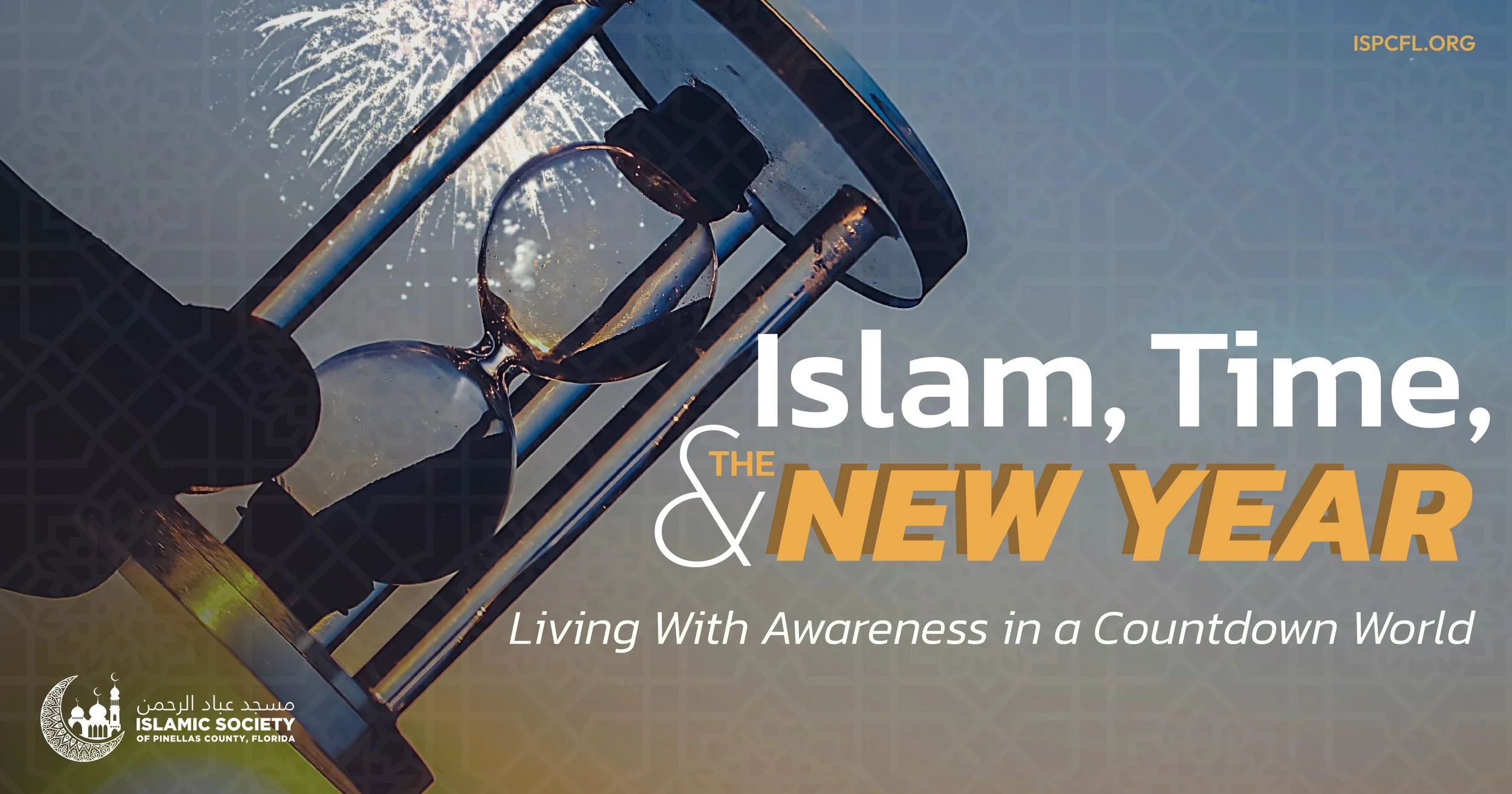
How does Islam view time? What does a real “fresh start” look like in Islam?
Every year, as December fades, much of the world pauses. There are countdowns, fireworks, champagne glasses raised, and resolutions loudly declared. All of this is built around a powerful idea repeated so often that it begins to feel unquestionable: “A new year means a fresh start.”
For Muslims living in modern societies, this moment often raises quiet, internal questions: Why do Muslims not celebrate New Year’s Eve? Is it not simply about hope and renewal? What could be wrong with wanting a clean slate? Islam does not dismiss reflection or renewal. However, it challenges the myth that this particular date carries inherent spiritual power, and it offers something far deeper and more enduring in its place.
Time is not a blank container into which human beings freely pour meaning according to preference. Rather, time is a creation of Allah, structured with wisdom, purpose, and accountability. The Qur’an reminds us that,
“Indeed, the number of months with Allah is twelve months… among them are four sacred months.”
This indicates something critical: not all moments are equal, and not every date can be declared sacred merely by human agreement. From an Islamic perspective, the sanctity of time is revealed, not invented. Specific days and months carry spiritual weight because Allah has designated them, such as Ramadan, the days of Hajj, and the four sacred months, not because societies have collectively decided to mark them with fireworks or social rituals. January 1st, therefore, holds no intrinsic spiritual meaning in Islam, not because Muslims are indifferent to time, but because revelation has already structured and sanctified time in a different way.
Gregorian New Year as a Human Convention
The New Year, celebrated on January 1st, is based on the Gregorian calendar, a civil system that emerged from historical Roman and later Christian contexts. It is a human convention, useful for organization, administration, and global coordination. Still, it is neither revealed nor tied to acts of worship in Islam, nor is it connected to moral accountability in and of itself.
Islam does not oppose the use of such calendars for worldly purposes; Muslims may work, study, and organize their lives according to them. However, Islam does not sacralize them. To celebrate the Gregorian New Year as a spiritually meaningful “reset” assumes something Islam does not affirm: that moral renewal is tied to a specific date, rather than to sincere repentance and return to Allah.
The “Reset Myth” and Its Emotional Appeal
The idea behind New Year’s Eve is emotionally powerful. It suggests that yesterday’s mistakes can be sealed off at midnight, that guilt somehow expires with the turning of the calendar, that accountability can be postponed until an external moment arrives, and that meaningful change will be easier tomorrow than it is today.
Islam offers a more honest and more demanding approach. It teaches that a person does not need a new year, a countdown, or a crowd to return to Allah. What is required is sincerity. From this perspective, the promise of New Year’s Eve is symbolic, while the promise of tawbah (repentance) is real. Renewal in Islam is not seasonal or ceremonial; it is available at any time, to any believer, in any place.
Repentance in Islam Is Always Open
Tawbah does not require a countdown.
In the Islamic tradition, renewal is not confined to a calendar transition. Tawbah does not require a countdown, does not wait for January, and does not depend on shared emotion or public declaration. It is accepted the moment it is sincere. A believer can return to Allah in the middle of the night, after years of distance, without witnesses, and without spectacle.
This constant accessibility makes the symbolism of New Year’s Eve spiritually unnecessary. The issue is not that joy or community gatherings are inherently forbidden, but that the idea of a magical “reset moment” at midnight is insufficient compared to the depth of Islamic teachings on repentance. Islam offers a door of return that remains open until death, not a yearly window that opens for a few emotional hours and then closes.

Celebration and Reflection
Two Very Different Modes
Islam strongly encourages reflection and self-accountability. Believers are urged to take themselves to account before they are taken to account, to reflect on their actions, to measure their time, and to prepare for the Hereafter. However, Islam also distinguishes between quiet, serious self-examination and public, ritualized celebration.
New Year’s Eve, as commonly observed, tends to replace introspection with distraction. Noise takes the place of reflection; festivity replaces seriousness; and passing emotion often stands in for sustained commitment. The Islamic preference is not for gloom over joy, but for depth over spectacle. Real moral change requires more than a date, a party, or a list of resolutions shouted over music.
Why Muslims Step Back from New Year’s Eve Rituals
Many customary New Year’s practices, as observed in much of the world, involve excess, intoxication, moral looseness, performative resolutions, and a kind of collective heedlessness that is normalized for one night. Islam does not forbid happiness or gathering with others, but it does warn against states of forgetfulness of Allah—especially when they are ritualized and celebrated.
For this reason, many Muslims choose to step back from New Year’s Eve rituals. This withdrawal is not a claim to moral superiority over others, but an act of moral self-preservation. It is a recognition that certain environments and practices are not conducive to spiritual presence, and that aligning one’s private and public life with remembrance of Allah is more important than conforming to social expectations.t behind. That truthfulness, though difficult in practice, is regarded as deeply honorable.
Islamic Calendar: A Different Rhythm of Life
Islam operates according to a lunar calendar that structures the believer’s life around acts of worship, sacred history, and spiritual milestones. Its months are tied to fasting in Ramaḍān, to pilgrimage in Dhū al-Ḥijjah, to the Hijrah (migration) and the moral lessons it carries, and to events of sacrifice, patience, and renewal through obedience.
This calendar is not arbitrary. It trains the believer to see time through the lens of meaning: days become significant not because a culture has selected them for celebration, but because Allah has connected them to worship, remembrance, and moral growth. In this way, the Islamic calendar teaches that life moves not by random milestones but by divinely-anchored moments that shape the heart and direct the soul.
What Real Renewal Looks Like in Islam
In the Islamic framework, real renewal is concrete. It consists of turning back to Allah with sincerity, repairing damaged relationships, abandoning sins one has normalized, recommitting to prayer, revising intentions, and aligning outward behavior with inward conviction.
None of this requires a new year, public declarations, or social momentum. It requires honesty with oneself and humility before Allah. Islam teaches believers not to delay repentance until a symbolic moment, because death does not wait for special occasions. The call is to seize the present as an opportunity, rather than to place hope in an artificial “fresh start” date.
Living With Awareness in a Countdown World
Muslims do not need to mock New Year’s Eve, lecture others, or isolate themselves in resentment toward broader society. They simply choose a different orientation. While the world counts down seconds to midnight, Islam asks a different kind of question: How many of those moments are being counted for the sake of Allah?
This is not a rejection of society or a refusal to live in the modern world. It is an alignment with eternity. Faith teaches that the true measure of time is not how dramatically we celebrate its passing, but how responsibly we live within it.
Closing Reflection: Islam accepts the idea of renewal; it rejects the notion that renewal derives from a date rather than from devotion. Muslims do not avoid New Year’s Eve because they fear change. They avoid treating it as a spiritual milestone because, in their belief, real change never needs a midnight signal.
In Islam, every breath is an opportunity, every sincere prayer is a reset, and every genuine return to Allah is a new beginning.

Consider supporting the Islamic Society of Pinellas Park, one of the largest community projects in South Florida, serving the growing needs of more than 100,000 Muslims in Pinellas and the Tampa Bay area.